Complete a line yourself
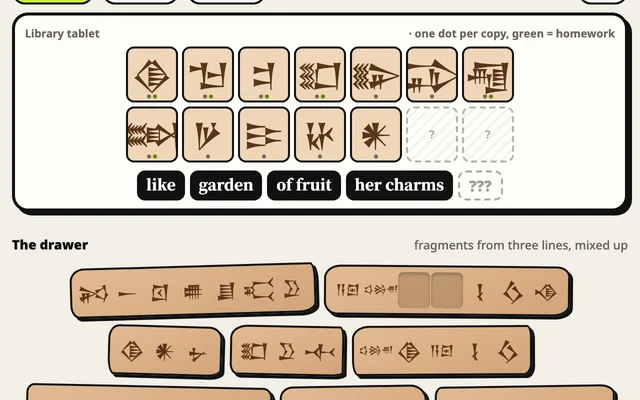
It works like the text matching in the video. Up top is one line of the poem on the temple-library tablet, with pieces broken off; the drawer below mixes up ten fragments from three different lines. You don't need to read cuneiform: find the fragments that share two or three signs in a row with the tablet and drag them up, and the missing signs and English words come back. All three are real lines from the poem, and the signs on every piece follow the scholars' published transcriptions.
 GameBabylonian Poem PuzzleOpen →
Mia's tips
- A single matching sign is usually a coincidence; look for a run. Line 3 hides one fragment that matches two signs by pure chance. See if it fools you.
- Some copies spell a word differently (one writes "river" as a single sign, another as two syllables). I counted those as the same slot, so don't fight that one.
- The little dots under each sign count the copies that agree on it, and a green dot is the homework: a real student's practice tablet from more than two thousand years ago. On lines 1 and 2, it's one of the copies that kept the opening signs.
- Really stuck? "Ask the computer" points at the best match, for a 10-second penalty. Finish all three lines to see how long checking 27,000 fragments would take you.
What the rebuilt poem says
A few passages: the top line of each pair is the Akkadian as the scholars reconstructed it, the bottom line their English translation, and […] marks clay that's still missing. Both come from Anmar A. Fadhil and Enrique Jiménez, A hymn in praise of Babylon and the Babylonians (Iraq 86), with line numbers from their edition; the puzzle's signs also follow it and eBL. The paper is published under CC BY-NC-SA 4.0, and this page shares it under the same license.
The city: a mountain heaped with gems
sikkūr sāmti dalat […]
Bolt of carnelian, gate of […],
semer tamlî pišanni […]
Inlaid ring, treasure chest of […],
ṣurru uqnû pappardilû šadû ša […]
Obsidian, lapis lazuli, agate, and mountains of […],
ašpû šūquru aban šarrūti
(And) precious jasper – gem of sovereignty.
kīma tâmti naši ḫiṣibšu
Like the sea, (Babylon) proffers her yield,
kīma kirî inbī lalîšu iḫannub
Like a garden of fruit, she flourishes in her charms,
Spring, brought by the Euphrates
purattu nāršu šiknat bēl nēmeqi nudimmud
The Euphrates is her river – established by wise lord Nudimmud –
umakkar bamāti ṣuṣê išaqqu
It quenches the lea, saturates the canebrake,
ana ayabi u tâmati unaqqi mêšu
Disgorges its waters into lagoon and sea,
qarbātūšu iptanarrâ dīša u šamma
Its fields burgeon with herbs and flowers,
tamerātūšu šunmurā iḫannub ašnan
Its meadows, in brilliant bloom, sprout barley,
šapkū ina libbīšu gurrunū karê nissaba
From which, gathered, sheaves are stacked,
gipāru u laḫru aburriš rabṣū
Herds and flocks lie on verdant pastures,
Mesopotamian literature rarely stops to describe a landscape. According to the paper, the only other long passage about spring arriving is the opening of the debate poem The Ox and the Horse.
The people: how Babylonians treat others
ramkūtu ša ištarān ša šamaš ebbūtu
Bathed priests of Ištarān, pure priests of Šamaš,
buḫlû ša šušinak nippurû ša ellil
Buḫlû-priests of Šušinak, Nippureans of Enlil —
aḫûti ša ittīšunu ul ušbaššū
The foreigners among them they do not humiliate.
ḫaššâ ḫatnū ābirîšunu kullū
The humble they protect, their weak they support,
ina ṣillīšunu akû iballuṭ enšu
Under their care, the poor and destitute can thrive.
ana mār mīti usāta ippušū išakkanū gimilla
To the orphan they offer succor and favor,
ṣabta umaššarū kasâ ipaṭṭarū (ana) ištēt bilat kaspi
The prisoner they set free, the captive they release (even) at the cost of a silver talent,
ša lā ašbu išakkanā zitta
With the absent person they share the inheritance,
kī ikki palḫi šuṣṣurū iribbū dumqa
Piously observing, they return kindness.
upaqqū ana dīn(i) ilim-ma kitta naṣrū
They follow the gods’ command, and justice they keep,
kudurru rēštû uṣurtu maḫrītu
The original stele, the ancient law.
Lines 133–134 say who those "foreigners" are: Šušinak was a god of Elam (in today's southwest Iran) and Nippur was another city. So "they do not humiliate the foreigners" is mostly about priests from elsewhere living in Babylon. A silver talent is roughly 30 kilograms.
The women: several kinds of priestesses
sinnišātu ša ina šiprīšina tašīmta aḫzā
(Their) women who have become masters in their duties:
ugbabātu ša ina ḫāmerīšina kitta naṣrā
High priestesses who keep (their) vow to their bridegrooms,
nadâtu ša ina nēmeqi uballaṭā rēma
Cloistered women who, with their skill, nourish the womb with life,
qašdātu ša ina mê tēlilti išakkanā šuḫta
Holy women who cleanse with pure water.
šunū-ma šubarrû ša marūtuk
They (the men) are the ones freed by Marduk.
Before this poem, what these classes of priestesses actually did had to be pieced together from scattered mentions; this is the first text that describes them at length. The whole section on the people ends with line 158.