The 217-year-old Napoleonic letter
The full text in French and English, the key, and code you can rerun yourself are in Carter Church's The Letter to Marmont; the cipher plate itself is at the end of the 1969 article on Persée.
The four letters I wrote: your turn
I wrote these four myself, so you won't find them online. Every ciphertext is here to copy: break it with pen and paper or hand it to your AI, then open the answer to check.
Letter two: the treasure note
An English note with every letter swapped for an odd symbol (22 kinds), spaces removed, 191 symbols. It's the simplest kind: one symbol per letter. Hint: look for three symbols that keep showing up together.
⚓∆♠⚓✿♠†Ω♣✿♠☼Ω☾§⚓♣☾¶♠✿⚓∆♠§†♥⚓✿♠♠‡✿§¤⚓∆♠§∞
¶µ♠∞∞µ†∞♥‡§✿⚓ß∂†ø♠Ω☾§✿⚓∆⚓♣✿☾∞♠‡⚓†⚓⚓∆♠¥✿§
♥♠☾Ω⚓†⚓♣♠†☾¶¶☼✚µ∆♠✿♠⚓∆♠Ω∆†¶§µ§‡⚓∆♠¥♠∞∞⚓§
µ♠✿‡†∞∞Ω†⚓☾§§☾⚓♠∞∞☾§§☾♠☾§⚓♠♦♠☾⚓∆♠ø†∂⚓†☼☾
†☾¶¥♣✿☾⚓∆☼Ω∞♠⚓⚓♠✿†‡⚓♠✿ߧ♣✿♠†¶☼⚓
Show answer
The treasure is not under the oak tree. From the old well walk forty paces north, turn left at the broken statue, and dig where the shadow of the bell tower falls at noon. Tell no one, not even the captain, and burn this letter after you read it.
Letter three: a Vigenère cipher
An English note, 223 letters, encrypted with the Vigenère cipher: an English word is the key, and each letter is shifted by the next letter of the key in turn. The key is a 7-letter English word.
TFLHYTNYRRTHKUTSLHYYNGEWNWKOCOXXRKUPCVILVEEHNMTVBA
LRVECYPDHGFIRLKNUPVSZRGAVVRSUAWVVQJENKWRSCEAVLUVAL
BFEKALMRWFCNTSRWIMVREAXVVTZTGAITEPDVMFLGLNVMECVLNA
TQVQMEYEEJBTNIXRKROIGYMIFEHVLXFEJIFGSKNWWNRWWNTRNG
HERTTUXVREPCBWISEPAXXVJ
Show answer and key
Key: LANTERN
If you can read this, you have just broken the cipher that people called unbreakable for three hundred years. A French diplomat named Blaise de Vigenere got the credit, but an Italian named Bellaso invented it first. History is not always fair, and neither are codebreakers.
Guess the key length first; once you have it, every seventh letter forms a group that is a simple substitution again.
Letter four: a Napoleonic number cipher
A French military order written the way the French army wrote them in 1809, encrypted the same way as Napoleon's letter: no spaces or accents, several numbers per letter (E has 8), 20 numbers that each stand for a whole common word, and 5 meaningless nulls. 986 numbers, 93 different ones. This is the hard one.
200 271 252 192 227 297 218 142 98 141 144 43 133 64 35 58 82 74 120 165
89 140 61 88 17 142 153 139 271 75 93 70 17 283 74 62 192 153 194 227
168 283 280 168 298 90 191 93 194 47 248 193 90 181 82 144 17 153 192 62
105 64 218 252 90 74 82 151 165 142 27 25 297 79 294 90 252 48 153 16
65 133 271 90 27 266 142 271 139 206 88 227 93 162 54 142 90 151 165 212
70 294 35 206 153 89 54 266 90 101 151 62 140 21 82 31 152 114 74 153
48 89 48 70 142 70 224 283 191 218 181 280 151 191 181 31 165 90 93 53
88 168 181 153 74 227 165 67 193 271 218 48 280 21 17 297 35 165 27 89
35 70 252 191 168 67 140 200 88 105 139 206 297 105 153 48 249 146 252 114
168 162 144 101 56 68 70 139 206 27 88 75 27 70 152 283 297 252 16 74
64 89 75 191 218 151 280 101 294 239 271 74 193 142 197 194 73 47 246 252
75 64 133 114 101 181 31 62 93 152 62 130 209 16 101 252 27 98 181 56
105 55 25 67 266 31 62 27 16 246 79 24 82 31 82 75 152 64 130 280
252 35 70 105 90 168 152 58 17 64 133 101 114 192 27 153 282 133 114 25
227 139 297 282 192 55 93 283 133 70 47 101 74 200 64 297 27 67 188 81
181 227 297 75 16 105 55 168 283 266 101 192 97 297 11 82 93 298 89 11
227 64 114 25 47 297 27 298 74 55 218 21 165 27 98 105 55 227 89 68
88 151 90 62 105 297 70 266 142 55 133 90 27 283 31 191 114 194 193 227
151 227 194 114 191 93 27 79 24 114 49 27 297 21 271 31 298 197 105 271
75 298 194 65 74 144 17 168 252 121 132 287 70 24 298 142 17 139 58 227
64 93 192 70 65 105 55 93 181 21 70 27 192 197 54 53 105 55 168 283
114 197 31 153 98 21 142 17 75 139 297 266 191 168 17 88 283 191 129 282
146 227 139 55 294 11 105 114 74 88 151 88 105 194 191 151 90 64 82 11
62 139 25 248 266 191 25 271 252 88 17 27 246 67 287 105 294 192 27 246
192 133 82 142 35 58 246 75 298 193 165 178 70 109 11 165 31 192 54 120
88 25 17 35 227 246 70 90 75 282 90 81 287 101 294 152 31 90 139 206
227 197 75 27 82 24 142 55 75 298 70 61 53 88 90 105 246 101 283 105
191 114 282 49 101 31 200 297 62 194 280 252 200 197 200 246 298 280 133 21
192 67 114 47 282 188 21 55 218 142 31 55 168 152 21 82 27 197 252 151
271 56 62 105 89 142 153 75 53 55 105 181 194 139 271 93 283 142 297 151
271 218 27 120 70 74 97 165 48 82 294 266 74 197 192 89 140 11 271 194
133 153 114 144 144 64 294 142 194 271 53 53 17 139 90 197 142 282 97 24
120 165 252 17 64 35 82 31 275 287 21 271 168 181 282 89 54 192 70 11
297 192 191 168 283 133 88 218 11 101 114 282 73 67 61 70 227 298 197 192
266 55 31 181 297 74 97 64 194 151 227 11 105 153 192 266 55 218 105 206
218 17 152 178 271 24 105 282 188 140 144 70 114 27 194 280 48 266 271 90
93 298 101 142 74 246 181 297 31 249 79 218 62 25 245 65 165 282 68 70
298 70 114 144 25 191 93 27 53 101 17 181 165 27 49 139 271 218 105 17
74 98 68 31 65 227 152 132 140 142 165 282 181 297 48 62 168 97 88 25
200 88 283 17 62 67 75 297 200 70 105 139 58 64 48 132 89 168 294 90
181 266 62 252 16 70 75 298 287 181 31 191 114 27 266 105 246 133 90 246
74 192 178 55 294 74 192 98 141 38 74 55 294 282 192 17 280 105 140 70
298 181 64 168 16 142 88 82 11 17 25 47 82 139 206 224 194 62 192 193
62 218 239 31 297 120 90 200 280 252 283 282 67 140 16 191 252 168 62 74
101 16 280 282 75 55 218 151 246 144 144 165 194 89 25 248 38 142 294 144
197 48 275 35 62 298 283 297 144 64 298 152 74 64 101 21 74 297 282 47
82 11 55 90 31 25 294 246 67 188 139 191 75 53 114 165 48 49 11 191
181 105 246 238 79 294 70 65 75 271 61 53 17 35 17 297 31 162 98 133
55 152 97 191 31 97 142 246 125 74 227 151 55 25 227 67 54 238 125 200
70 142 246 93 212 271
Want part of the key?
Like the table that survived from 1809, here is a third of the key (23 numbers), all correct:
11 = V
17 = I
27 = S
31 = R
48 = Z
55 = O
58 = H
61 = F
64 = E
70 = A
88 = A
90 = I
144 = L
146 = K
168 = N
192 = S
193 = D
197 = E
227 = I
239 = X
266 = P
271 = O
280 = E
Show answer
Monsieur le Général, l'Empereur me charge de vous faire connaître ses intentions. L'armée d'Italie se réunira vers le quinze du mois prochain sur la rive gauche de la Piave. Vous partirez de Zara avec toute votre infanterie et douze pièces de canon, et vous marcherez par Knin sur Laybach sans attendre de nouveaux ordres. L'ennemi a trente mille hommes dans le Tyrol et près de quarante mille en Carinthie, mais ses milices sont mal armées et ne tiendront pas devant de vieilles troupes. Le roi de Bavière a promis trois divisions, qui se porteront sur l'Inn dès que les Autrichiens auront passé la frontière. Le prince Poniatowski couvrira Varsovie avec l'armée polonaise, et les Russes marchent déjà vers la Galicie. Ainsi les Autrichiens auront affaire à trois armées en même temps, et ils ne pourront pas envoyer de renforts contre vous. Gardez auprès de vous vos meilleurs officiers du génie, car les ponts de la Save sont mauvais, et faites porter des vivres pour huit jours. Ne vous laissez point arrêter par quelques bataillons. Faites courir le bruit que vous restez en Dalmatie, et ne marchez que de nuit pendant les trois premiers jours. Le général Broussier vous attendra à Villach avec ses deux régiments et vous donnera des nouvelles de l'armée. Brûlez cette lettre après l'avoir lue, et ne confiez votre réponse qu'à un officier sûr. Le mot d'ordre sera Rivoli, et la réponse sera Marengo.
General, the Emperor has charged me to make his intentions known to you. The Army of Italy will assemble around the fifteenth of next month on the left bank of the Piave. You will leave Zara with all your infantry and twelve guns, and march by Knin on Laybach without waiting for new orders. The enemy has thirty thousand men in the Tyrol and nearly forty thousand in Carinthia, but his militia are badly armed and will not stand against old troops. The King of Bavaria has promised three divisions, which will move on the Inn as soon as the Austrians cross the border. Prince Poniatowski will cover Warsaw with the Polish army, and the Russians are already marching toward Galicia. So the Austrians will have three armies to deal with at once, and cannot send reinforcements against you. Keep your best engineer officers with you, for the bridges on the Sava are bad, and carry food for eight days. Do not let a few battalions stop you. Spread the word that you are staying in Dalmatia, and march only by night for the first three days. General Broussier will wait for you at Villach with his two regiments and give you news of the army. Burn this letter after reading it, and trust your reply only to a reliable officer. The password will be Rivoli, and the countersign Marengo.
Letter five: a scanned-style letter
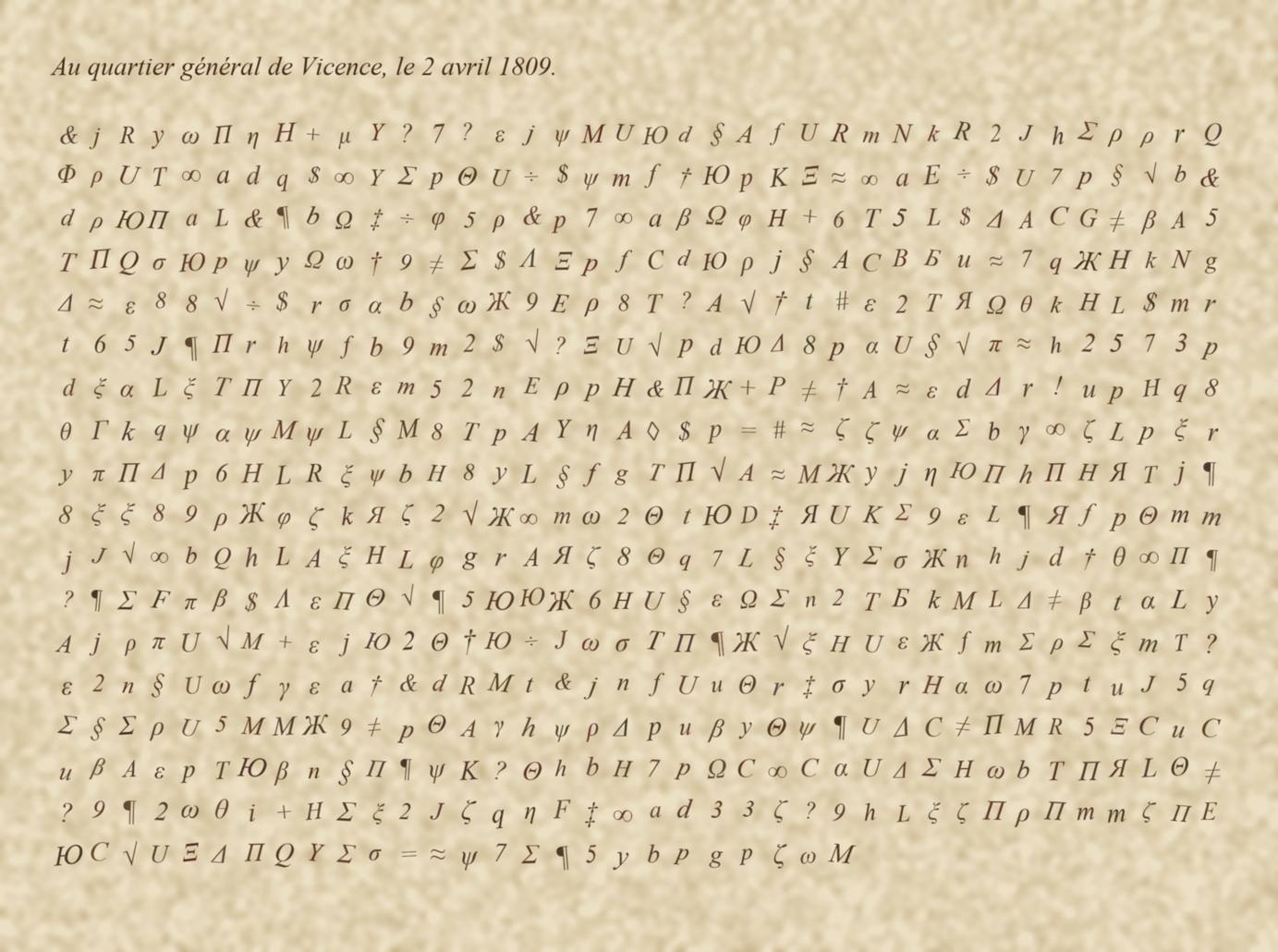
Another French order from 1809, same method, made into a "scan": Greek and Russian letters, digits and assorted marks, 672 symbols of 88 kinds. Like the real letter, the first line isn't encrypted. You have to copy the symbols out first, and one wrong copy ruins everything after it.
Show answer
Au quartier général de Vicence, le 2 avril 1809.
Monsieur le duc, je reçois à l'instant la nouvelle que l'archiduc Jean a quitté Laybach avec quarante mille hommes et qu'il marche sur le Frioul. Sa Majesté désire que vous laissiez deux bataillons à Zara pour garder la place, et que vous veniez avec le reste de votre corps par la route de Fiume. Évitez toute bataille avant d'avoir fait votre jonction avec l'armée. Le pont de Sacile sera gardé par la division Seras jusqu'à votre arrivée. Les Croates de la frontière sont prêts à se soulever ; promettez-leur la protection de l'Empereur, et payez comptant tout ce que vos troupes prendront. Je vous envoie par ce même courrier deux cent mille francs en or pour la solde de vos soldats. Le colonel qui vous remettra cette lettre connaît les chemins de montagne et vous servira de guide. Ne laissez dans les villages ni malades ni bagages, car l'ennemi y enverra sa cavalerie. Répondez-moi par le retour du courrier, et chiffrez votre lettre avec la table que je vous ai remise à Paris.
Headquarters at Vicenza, 2 April 1809. My lord Duke, I have just received word that Archduke John has left Laybach with forty thousand men and is marching on Friuli. His Majesty wishes you to leave two battalions at Zara to hold the town, and to come with the rest of your corps by the Fiume road. Avoid any battle before you have joined the army. The bridge at Sacile will be guarded by Seras's division until you arrive. The Croats of the frontier are ready to rise; promise them the Emperor's protection, and pay cash for everything your troops take. By this same courier I am sending you two hundred thousand francs in gold for your soldiers' pay. The colonel who hands you this letter knows the mountain roads and will be your guide. Leave neither sick men nor baggage in the villages, for the enemy will send his cavalry there. Answer me by the returning courier, and encipher your letter with the table I gave you in Paris.
Letter six: K4, the answer is still in a safe
The K4 challenge prompt
Paste it into Claude, ChatGPT or whatever AI you use. One that can browse and run its own code is best (Claude Code, Codex, or a chat app with code execution on), but it works without them too: the whole puzzle is in the prompt.
I want to take on a real unsolved puzzle: Kryptos K4. Be my codebreaking partner. Here's the puzzle, the rules, and how to check an answer.

THE PUZZLE
Kryptos is a copper sculpture by the American artist Jim Sanborn, put up in 1990 in the courtyard of CIA headquarters in Langley, Virginia. Four encrypted passages are cut into it. The first three (K1–K3) were cracked in the 1990s. The fourth, K4, is only 97 letters long, and in more than thirty years nobody has publicly solved it. In November 2025, Sanborn's Kryptos archive, answer included, sold at auction for $962,500. The buyer, Paradigm, keeps the answer locked away and hasn't published it.

K4 ciphertext, 97 capital letters, positions counted from 1:
OBKRUOXOGHULBSOLIFBBWFLRVQQPRNGKSSOTWTQSJQSSEKZZWATJKLUDIAWINFBNYPVTTMZFPKWGDKZXTJCDIGKUHUAUEKCAR

In groups of ten, so positions are easy to find (the number is the position of the first letter in the row):
1   OBKRUOXOGH
11  ULBSOLIFBB
21  WFLRVQQPRN
31  GKSSOTWTQS
41  JQSSEKZZWA
51  TJKLUDIAWI
61  NFBNYPVTTM
71  ZFPKWGDKZX
81  TJCDIGKUHU
91  AUEKCAR

If you can browse the web, first check the ciphertext and the clues below against the sources: the Kryptos article on English Wikipedia (https://en.wikipedia.org/wiki/Kryptos) and Paradigm's official K4 page (https://www.paradigm.xyz/kryptos/k4). If anything differs from what I gave you, tell me before you start. No web access is fine too: everything you need is right here.

SANBORN'S FOUR OFFICIAL CLUES (the plaintext is English; positions count from 1)
- 22–25: FLRV → EAST
- 26–34: QQPRNGKSS → NORTHEAST
- 64–69: NYPVTT → BERLIN
- 70–74: MZFPK → CLOCK
Put together, positions 22–34 read EASTNORTHEAST and positions 64–74 read BERLINCLOCK. Any candidate answer has to match all 24 of these letters exactly. If it doesn't, throw it out.

RULES
1. Don't make anything up. If you can't crack it, say so, and tell me how far you got and which methods you ruled out. "I don't know" is worth far more than a paragraph that only looks like English.
2. If you can write and run code, search with a program. But before you run it on the real K4, test it: pick an English sentence, encrypt it with the method you're testing and a key of your own choosing to make a fake ciphertext with a planted answer, and check that your program recovers it. Only then does zero hits on K4 mean "this method is wrong" rather than "my code is broken."
3. If you can't run code, don't pretend you did. Tell me how far you got by hand and what still needs a program to check.
4. Don't hand me a "solution" someone claimed online, recalled from memory, as if it were your own.
5. You don't need to submit anything for me. Give me the result and I'll decide whether to submit it.

WHERE TO START (suggestions)
- The first three passages are a useful reference: K1 and K2 are Vigenère with an alphabet scrambled by the word KRYPTOS, and K3 is a transposition. Don't assume K4 works the same way.
- Use the four clues as constraints and test one family at a time: periodic Vigenère, Beaufort (both the standard and the KRYPTOS alphabet), autokey, transposition followed by a key, and so on. For each family, note what you tried and what came out.

HOW TO HAND IN
- Verdict first: cracked or not cracked.
- If you have a candidate: all 97 letters in capitals with no spaces (positions 22–34 are EASTNORTHEAST, 64–74 are BERLINCLOCK), then a readable version with spaces.
- Method and key: which cipher, what key, and every step from ciphertext to plaintext, so anyone can reproduce it.
- Why it's believable: beyond those 24 letters, what reads as natural English, whether the whole thing makes sense, and whether it could be a coincidence you forced. End with a confidence from 0 to 100%.

HOW TO CHECK AN ANSWER
Paradigm, the company that bought the answer, runs an official checker at https://www.paradigm.xyz/kryptos/k4. Click "Decrypt K4", fill the 97 boxes, describe your method and leave an email address. It's $1 per submission, and whether you're right comes back privately, by email only. The answer is stored as a hash, and not even Paradigm has looked at it. There's no prize for K4 (the official rules say so); what you get is the answer itself. So a candidate should pass every check above before it's worth that $1.
Mia's tips
- If your AI hands you smooth English after a few minutes, don't celebrate yet. Check positions 22–34 and 64–74 first, then make it show you the method and key, and redo the math yourself.
- Keep rule 2 in the prompt: before touching the real thing, it builds a fake ciphertext with a planted answer and makes sure its program can find it. That way, zero hits on K4 means the method is wrong, not the code.
- Answers go in on Paradigm's K4 page. Think before you submit: it's $1 a try, and there's no prize even if you're right. But an answer someone paid $962,500 for, worked out by your own AI? That's bragging rights for life.